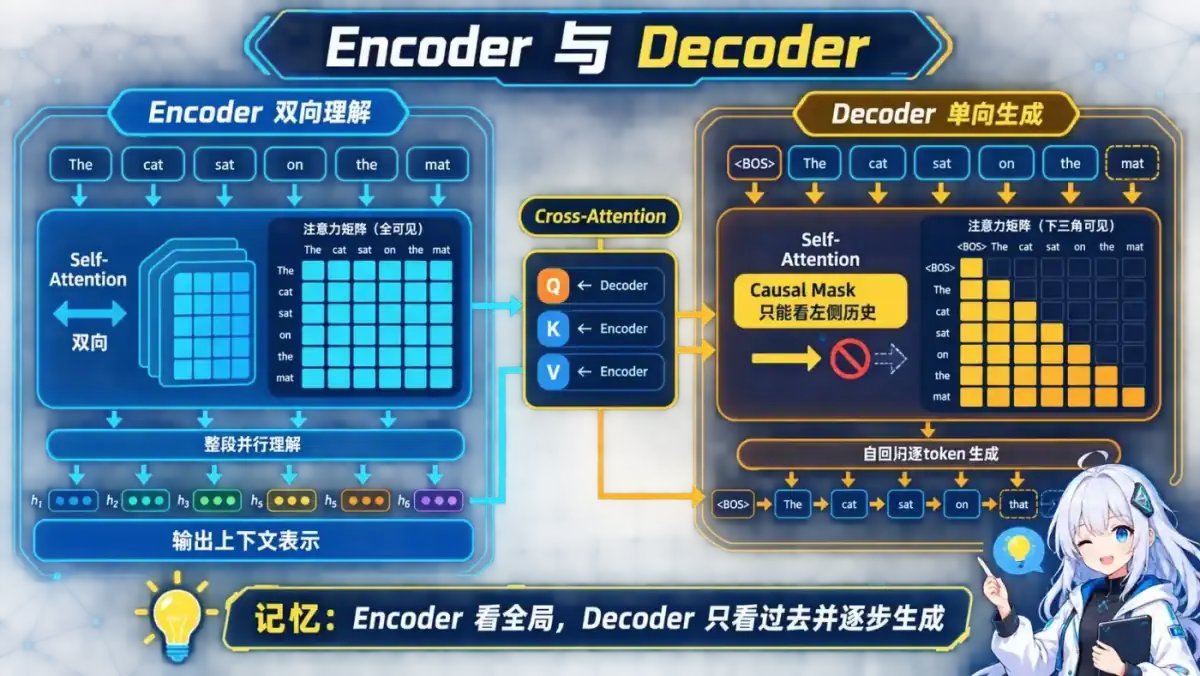
🧠 图解记忆:Encoder 看全局,Decoder 只看过去并逐步生成;点击图片可查看原图。
💡 答案要点
核心区别:Encoder是双向的,Decoder是单向的
Encoder(编码器):
python
# Encoder 结构(重复N次,通常N=6)
for layer in range(N):
    # 1. Multi-Head Self-Attention
    # 可以看到整个输入序列(双向)
    attn_output = MultiHeadAttention(
        Q=x, K=x, V=x  # Query、Key、Value 都来自输入
    )
    x = LayerNorm(x + attn_output)  # 残差 + 归一化

    # 2. Feed-Forward Network
    ffn_output = FeedForward(x)
    x = LayerNorm(x + ffn_output)
特点:
- ✅ 双向注意力(可以看到前后文)
- ✅ 并行处理所有token
- ✅ 输出:编码后的表示(上下文向量)
Decoder(解码器):
python
# Decoder 结构(重复N次,通常N=6)
for layer in range(N):
    # 1. Masked Multi-Head Self-Attention
    # 只能看到当前及之前的token(单向)
    masked_attn = MaskedMultiHeadAttention(
        Q=y, K=y, V=y,  # 来自目标序列
        mask=causal_mask  # 上三角mask
    )
    y = LayerNorm(y + masked_attn)

    # 2. Encoder-Decoder Cross-Attention
    # Query来自Decoder,Key和Value来自Encoder输出
    cross_attn = MultiHeadAttention(
        Q=y,  # 来自 Decoder
        K=encoder_output,  # 来自 Encoder
        V=encoder_output   # 来自 Encoder
    )
    y = LayerNorm(y + cross_attn)

    # 3. Feed-Forward Network
    ffn_output = FeedForward(y)
    y = LayerNorm(y + ffn_output)
特点:
- ⚠️ 单向注意力(Masked,只能看之前的)
- ✅ 包含Cross-Attention(连接Encoder和Decoder)
- ⚠️ 自回归生成(逐个token生成)
关键差异对比:
| 维度 | Encoder | Decoder |
|---|---|---|
| Self-Attention | 双向(无mask) | 单向(有mask) |
| Cross-Attention | ❌ 无 | ✅ 有(连接Encoder) |
| 输入 | 源序列(如英文) | 目标序列(如中文) |
| 输出 | 编码表示 | 生成序列 |
| 应用 | BERT(仅Encoder) | GPT(仅Decoder) |
Mask 机制详解:
# Encoder: 无mask,所有token都能互相看到
Input:  [I, love, AI]
Attention Matrix:
      I   love  AI
I    ✓    ✓    ✓
love ✓    ✓    ✓
AI   ✓    ✓    ✓

# Decoder: Causal Mask,只能看当前及之前
Input:  [我, 喜欢, 人工智能]
Attention Matrix:
        我  喜欢  人工智能
我      ✓   ✗    ✗
喜欢    ✓   ✓    ✗
人工智能 ✓   ✓    ✓
面试话术:
"Encoder用双向Self-Attention理解输入,Decoder用单向Masked Attention生成输出。Decoder还有Cross-Attention层,让生成的每个token都能关注Encoder的所有输出。BERT只用Encoder(理解任务),GPT只用Decoder(生成任务)。"