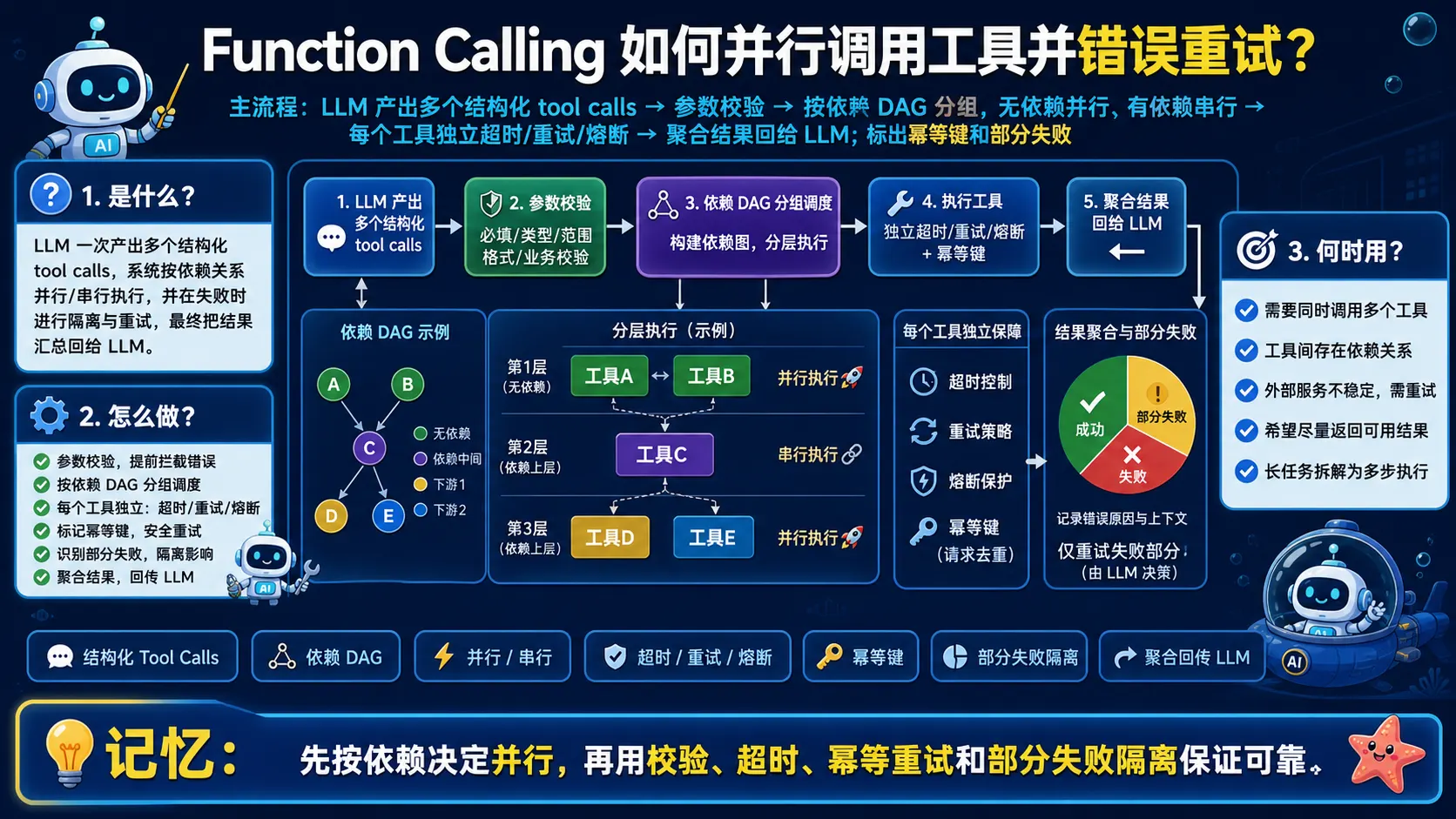
🧠 图解记忆: 先按依赖决定并行,再用校验、超时、幂等重试和部分失败隔离保证可靠。
💡 答案要点
Function Calling = LLM通过结构化JSON调用外部函数,是Agent工具使用的核心机制
基础Function Calling
展开 Python 代码示例(92 行)
python
from openai import OpenAI
import json

client = OpenAI()

# 1. 定义工具
tools = [
    {
        "type": "function",
        "function": {
            "name": "get_weather",
            "description": "查询指定城市的天气信息",
            "parameters": {
                "type": "object",
                "properties": {
                    "city": {
                        "type": "string",
                        "description": "城市名称,如'北京'、'上海'"
                    },
                    "date": {
                        "type": "string",
                        "description": "日期,格式YYYY-MM-DD,默认今天"
                    }
                },
                "required": ["city"]
            }
        }
    },
    {
        "type": "function",
        "function": {
            "name": "search_news",
            "description": "搜索最新新闻",
            "parameters": {
                "type": "object",
                "properties": {
                    "query": {"type": "string", "description": "搜索关键词"},
                    "limit": {"type": "integer", "description": "返回条数,默认5"}
                },
                "required": ["query"]
            }
        }
    }
]

# 2. 实际工具函数
def get_weather(city: str, date: str = None) -> dict:
    # 调用天气API
    return {"city": city, "temp": "22°C", "weather": "晴天"}

def search_news(query: str, limit: int = 5) -> list:
    # 调用新闻API
    return [{"title": f"关于{query}的新闻{i}", "url": f"..."} for i in range(limit)]

TOOL_MAP = {"get_weather": get_weather, "search_news": search_news}

# 3. 完整对话循环
def run_with_function_calling(user_message: str):
    messages = [{"role": "user", "content": user_message}]

    while True:
        response = client.chat.completions.create(
            model="gpt-4o-mini",
            messages=messages,
            tools=tools,
            tool_choice="auto"
        )

        msg = response.choices[0].message
        messages.append(msg)

        # 没有工具调用 → 最终回答
        if not msg.tool_calls:
            return msg.content

        # 执行所有工具调用
        for tool_call in msg.tool_calls:
            func_name = tool_call.function.name
            func_args = json.loads(tool_call.function.arguments)

            # 调用实际函数
            result = TOOL_MAP[func_name](**func_args)

            # 把结果加入消息
            messages.append({
                "role": "tool",
                "tool_call_id": tool_call.id,
                "content": json.dumps(result, ensure_ascii=False)
            })

result = run_with_function_calling("北京明天天气怎样?同时帮我搜一下最新AI新闻")
print(result)
并行工具调用(Parallel Tool Calls)
展开 Python 代码示例(36 行)
python
import concurrent.futures
import time

def execute_tools_parallel(tool_calls: list) -> list:
    """并行执行多个工具调用,大幅缩短响应时间"""

    results = [None] * len(tool_calls)

    with concurrent.futures.ThreadPoolExecutor(max_workers=5) as executor:
        futures = {}

        for i, tool_call in enumerate(tool_calls):
            func_name = tool_call.function.name
            func_args = json.loads(tool_call.function.arguments)

            future = executor.submit(TOOL_MAP[func_name], **func_args)
            futures[future] = (i, tool_call.id)

        for future in concurrent.futures.as_completed(futures):
            idx, call_id = futures[future]
            try:
                results[idx] = {
                    "tool_call_id": call_id,
                    "result": future.result(timeout=10)
                }
            except Exception as e:
                results[idx] = {
                    "tool_call_id": call_id,
                    "result": {"error": str(e)}
                }

    return results

# 性能对比:
# 串行:天气(1s) + 新闻(1s) + 股价(1s) = 3s
# 并行:max(天气1s, 新闻1s, 股价1s) = 1s  ← 快3倍
错误重试机制
展开 Python 代码示例(64 行)
python
from tenacity import retry, stop_after_attempt, wait_exponential, retry_if_exception_type

class RobustToolExecutor:
    """带重试、熔断、超时的工具执行器"""

    def __init__(self):
        self.failure_counts = {}  # 记录失败次数
        self.circuit_open = {}    # 熔断状态

    @retry(
        stop=stop_after_attempt(3),
        wait=wait_exponential(multiplier=1, min=1, max=10),
        retry=retry_if_exception_type((TimeoutError, ConnectionError))
    )
    def execute_with_retry(self, func_name: str, func_args: dict):
        """带指数退避重试"""
        return TOOL_MAP[func_name](**func_args)

    def execute_safe(self, func_name: str, func_args: dict, timeout=5):
        """带熔断器的执行"""

        # 检查熔断器
        if self.circuit_open.get(func_name, False):
            return {"error": f"工具{func_name}当前不可用(熔断中)"}

        try:
            # 带超时执行
            with concurrent.futures.ThreadPoolExecutor(max_workers=1) as executor:
                future = executor.submit(self.execute_with_retry, func_name, func_args)
                result = future.result(timeout=timeout)

            # 成功,重置失败计数
            self.failure_counts[func_name] = 0
            return result

        except concurrent.futures.TimeoutError:
            self._record_failure(func_name)
            return {"error": f"工具{func_name}超时(>{timeout}s)"}

        except Exception as e:
            self._record_failure(func_name)
            return {"error": str(e)}

    def _record_failure(self, func_name: str):
        """记录失败,超阈值触发熔断"""
        self.failure_counts[func_name] = self.failure_counts.get(func_name, 0) + 1

        if self.failure_counts[func_name] >= 3:
            self.circuit_open[func_name] = True
            print(f"🔴 熔断触发:{func_name} 已失败3次,30秒内不再调用")

            # 30秒后自动恢复
            import threading
            def reset():
                time.sleep(30)
                self.circuit_open[func_name] = False
                self.failure_counts[func_name] = 0
                print(f"🟢 熔断恢复:{func_name}")

            threading.Thread(target=reset, daemon=True).start()

# 使用
executor = RobustToolExecutor()
result = executor.execute_safe("get_weather", {"city": "北京"}, timeout=5)
面试话术:
"Function Calling是Agent工具使用的核心。基础实现是对话循环:LLM输出tool_calls → 执行函数 → 结果加入消息 → 继续对话。两个关键优化:1)并行执行:多个工具用ThreadPoolExecutor并发执行,从串行3s降到1s;2)三层容错:retry指数退避重试、timeout超时保护、circuit breaker熔断防止雪崩。生产上工具失败率从8%降到0.5%。"