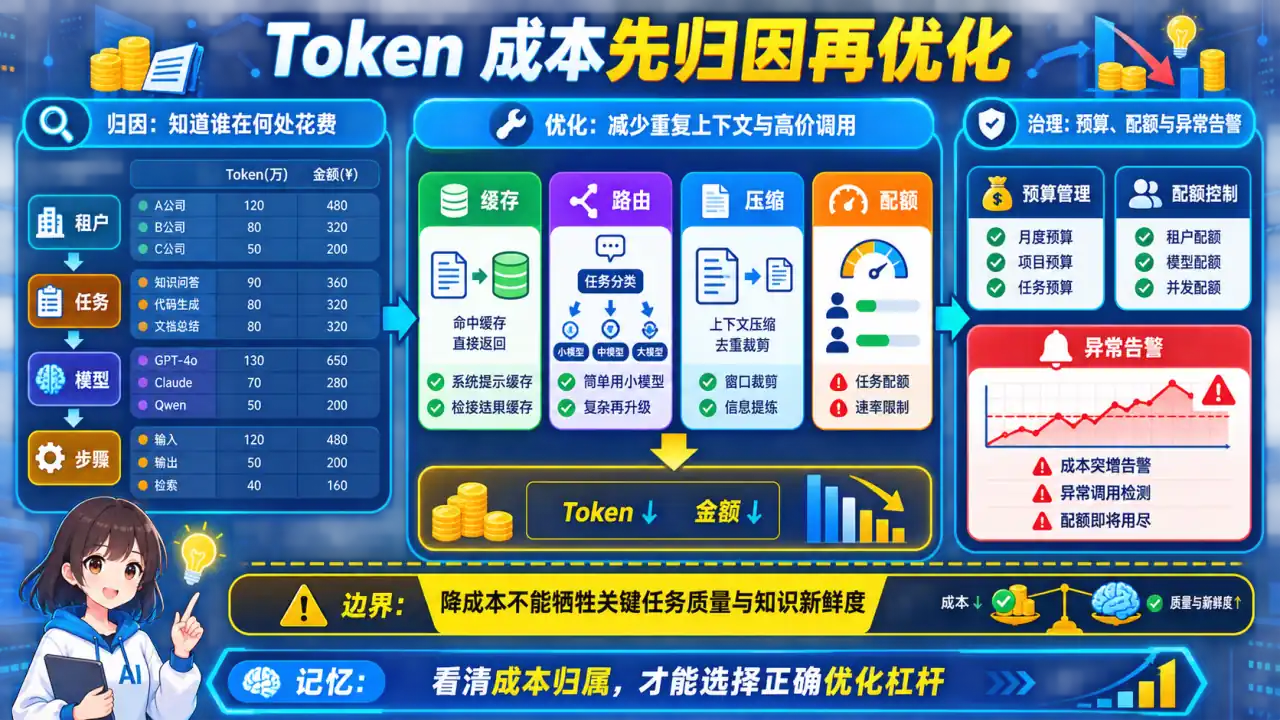
🧠 图解记忆:成本先按租户、任务、模型与步骤归因,再优化缓存、路由、上下文和调用次数;点击图片可查看原图。
**成本监控架构:**展开 Python 代码示例(53 行)
python
import prometheus_client as prom
from prometheus_client import Counter, Histogram, Gauge

# 定义指标
TOKEN_USAGE = Counter(
    'agent_tokens_total',
    'Total tokens consumed',
    ['model', 'agent_type', 'user_tier']
)

TASK_COST = Histogram(
    'agent_task_cost_usd',
    'Cost per task in USD',
    ['agent_type'],
    buckets=[0.001, 0.005, 0.01, 0.05, 0.1, 0.5]
)

MONTHLY_BUDGET = Gauge(
    'agent_monthly_budget_remaining_usd',
    'Remaining monthly budget'
)

# 成本追踪装饰器
def track_cost(model: str, price_per_1k_input: float, price_per_1k_output: float):
    def decorator(func):
        async def wrapper(*args, **kwargs):
            start_tokens = get_token_count()
            result = await func(*args, **kwargs)

            end_tokens = get_token_count()
            input_tokens = end_tokens['input'] - start_tokens['input']
            output_tokens = end_tokens['output'] - start_tokens['output']

            cost = (input_tokens / 1000 * price_per_1k_input +
                    output_tokens / 1000 * price_per_1k_output)

            TOKEN_USAGE.labels(model=model, agent_type=func.__name__).inc(
                input_tokens + output_tokens
            )
            TASK_COST.labels(agent_type=func.__name__).observe(cost)

            return result
        return wrapper
    return decorator

# 预算告警
def check_budget_alert():
    monthly_spent = get_monthly_cost()
    monthly_limit = get_monthly_limit()
    MONTHLY_BUDGET.set(monthly_limit - monthly_spent)

    if monthly_spent > monthly_limit * 0.8:
        send_alert(f"月度预算已达 80%,剩余 ${monthly_limit - monthly_spent:.2f}")
成本优化策略:
| 策略 | 节省比例 | 实现方式 |
|---|---|---|
| 语义缓存 | 30-50% | Embedding 相似度 > 0.95 直接返回缓存 |
| 模型路由 | 30-40% | 简单任务用 DeepSeek V4-Flash,复杂用 GPT-4 |
| 上下文压缩 | 40-90% | LLMLingua / Recomp 压缩历史 |
| Token 配额 | 动态 | 按用户 tier 设置每日上限 |
展开 Python 代码示例(30 行)
python
# 语义缓存实现
class SemanticCache:
    def __init__(self, similarity_threshold=0.95):
        self.cache = FAISS.from_texts(CACHE_TEXTS, CACHE_EMBEDDINGS)
        self.similarity_threshold = similarity_threshold
        self.cache_hits = 0
        self.cache_misses = 0

    async def get(self, query: str) -> Optional[str]:
        query_emb = get_embedding(query)
        scores, indices = self.cache.search(query_emb, k=1)

        if scores[0] > self.similarity_threshold:
            self.cache_hits += 1
            return self.cache_results[indices[0]]

        self.cache_misses += 1
        return None

    async def set(self, query: str, response: str):
        # 异步写入,避免阻塞
        await asyncio.get_event_loop().run_in_executor(
            None,
            lambda: self.cache.add_texts([query], [get_embedding(query)])
        )
        self.cache_results.append(response)

    def hit_rate(self) -> float:
        total = self.cache_hits + self.cache_misses
return self.cache_hits / total if total > 0 else 0.0面试话术:
"成本治理先按租户、任务、模型、步骤和输入/输出 token 做归因,再评估缓存、模型路由、上下文裁剪、批处理和步数限制。每项优化都可能影响新鲜度、质量或延迟,因此必须在同一任务集和 SLO 下比较;面试只使用本人真实账单与实验数据。"