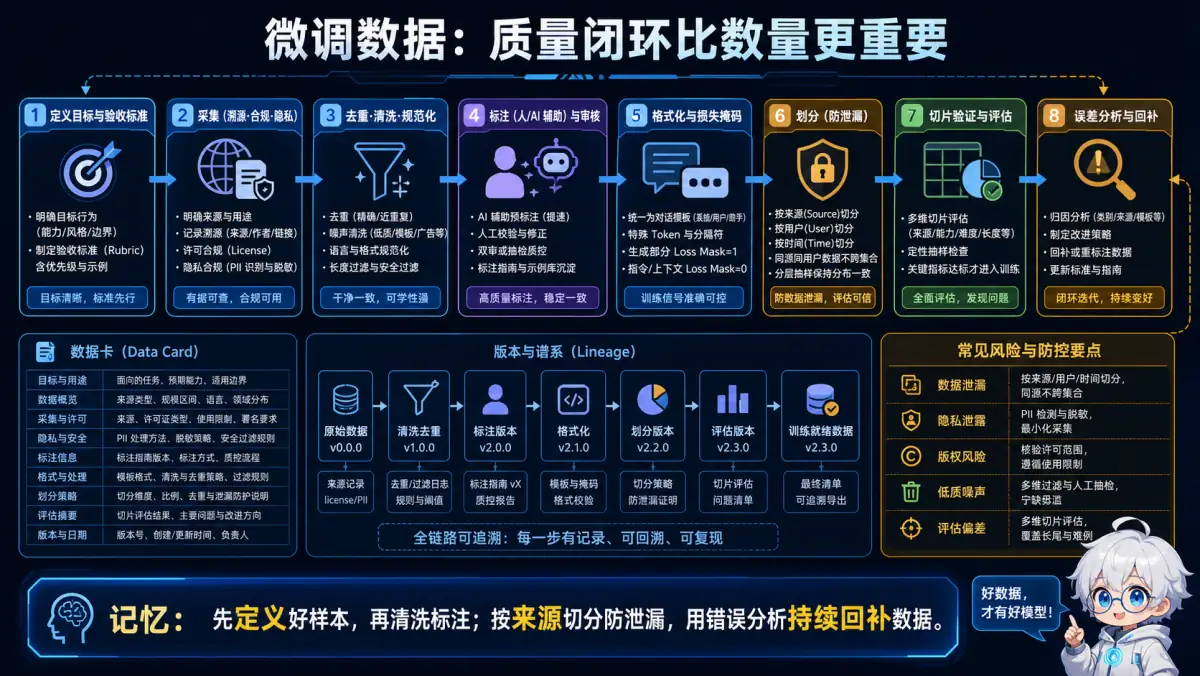
🧠 记忆锚点:先定义好样本,再清洗标注;按来源切分防泄漏,用错误分析持续回补数据。
💡 答案要点
数据质量 > 数据数量
数据准备流程(6步)
Step 1: 需求分析
python
# 明确微调目标
task_requirements = {
    "任务类型": "客服问答",  # 分类/生成/对话等
    "领域": "电商",
    "数据量需求": "至少1000条",
    "质量要求": "准确率>95%"
}
Step 2: 数据收集
| 来源 | 优点 | 缺点 | 适用 |
|---|---|---|---|
| 真实业务数据 | 最贴近实际 | 可能有噪声 | 首选 |
| 公开数据集 | 免费,量大 | 可能不匹配领域 | 补充 |
| 人工标注 | 质量可控 | 成本高 | 高质量小数据 |
| LLM生成 | 快速,便宜 | 可能有偏差 | 数据增强 |
Step 3: 数据清洗
展开 Python 代码示例(48 行)
python
def clean_training_data(raw_data):
    """数据清洗pipeline"""
    cleaned = []

    for item in raw_data:
        # 1. 去重
        if is_duplicate(item, cleaned):
            continue

        # 2. 过滤低质量
        if len(item["instruction"]) < 10:  # 问题太短
            continue
        if len(item["output"]) < 20:  # 回答太短
            continue

        # 3. 过滤有害内容
        if contains_sensitive(item["output"]):
            continue

        # 4. 格式标准化
        item["instruction"] = normalize_text(item["instruction"])
        item["output"] = normalize_text(item["output"])

        # 5. 语言过滤(只保留中文)
        if not is_chinese(item):
            continue

        cleaned.append(item)

    return cleaned

def normalize_text(text):
    """文本标准化"""
    # 统一标点符号
    text = text.replace(",", ",")
    text = text.replace("。", ".")

    # 去除多余空格
    text = re.sub(r'\s+', ' ', text).strip()

    # 统一大小写(英文)
    return text

# 使用
raw_data = load_raw_data("customer_service.jsonl")
cleaned = clean_training_data(raw_data)
print(f"清洗前: {len(raw_data)}, 清洗后: {len(cleaned)}")
# 清洗前: 5000, 清洗后: 3200 (过滤掉36%)
Step 4: 数据标注
展开 Python 代码示例(64 行)
python
# 方法1: 人工标注(最准确但慢)
def manual_annotation():
    """人工标注流程"""
    for item in unlabeled_data:
        # 展示给标注员
        display(item["input"])

        # 标注员选择/输入答案
        label = annotator.label(item)

        # 质量检查:双人标注,一致性>90%
        label2 = annotator2.label(item)
        if label != label2:
            # 不一致,提交专家仲裁
            label = expert.resolve(item, label, label2)

        item["output"] = label

# 方法2: LLM辅助标注(快但需验证)
def llm_assisted_annotation(data):
    """LLM自动标注"""
    for item in data:
        # 用GPT-4生成标注
        prompt = f"""
        任务: 客服问答
        问题: {item["question"]}

        请生成专业的客服回答(100-200字):
        """

        label = gpt4.generate(prompt, temperature=0.3)
        item["output"] = label

    # 人工抽检20%
    sample = random.sample(data, int(len(data) * 0.2))
    for item in sample:
        human_check(item)

# 方法3: 主动学习(聪明标注)
def active_learning_annotation(data, budget=1000):
    """优先标注最有价值的数据"""

    # 用已有少量数据训练初始模型
    model = train_initial_model(labeled_data[:100])

    while len(labeled_data) < budget:
        # 让模型预测未标注数据
        predictions = model.predict(unlabeled_data)

        # 选择模型最不确定的样本
        uncertain_samples = select_uncertain(predictions, k=50)

        # 人工标注这些样本
        newly_labeled = manual_annotation(uncertain_samples)

        # 加入训练集,重新训练
        labeled_data.extend(newly_labeled)
        model = train_model(labeled_data)

    return labeled_data

# 效果:
# 随机标注1000条: 准确率75%
# 主动学习1000条: 准确率82% (+7%)
Step 5: 数据格式化
python
# 标准格式: Alpaca格式
alpaca_format = {
    "instruction": "用户的指令/问题",
    "input": "额外的输入上下文(可选)",
    "output": "期望的输出"
}

# 示例数据
training_data = [
    {
        "instruction": "总结以下文章的主要内容",
        "input": "人工智能正在改变世界...(长文)",
        "output": "本文主要讲述了人工智能的三大影响:..."
    },
    {
        "instruction": "这个产品的退货政策是什么?",
        "input": "",
        "output": "我们提供7天无理由退货服务。退货流程:..."
    }
]

# 保存为JSONL
with open("train.jsonl", "w") as f:
    for item in training_data:
        f.write(json.dumps(item, ensure_ascii=False) + "\n")
Step 6: 数据验证
展开 Python 代码示例(44 行)
python
def validate_training_data(data):
    """数据质量检查"""

    issues = []

    # 检查1: 分布均衡
    categories = [item.get("category") for item in data]
    counter = Counter(categories)

    for cat, count in counter.items():
        ratio = count / len(data)
        if ratio < 0.05 or ratio > 0.5:
            issues.append(f"类别'{cat}'占比{ratio:.1%},不均衡")

    # 检查2: 长度分布
    lengths = [len(item["output"]) for item in data]
    avg_len = sum(lengths) / len(lengths)

    if avg_len < 50:
        issues.append(f"平均输出长度{avg_len}太短")

    # 检查3: 重复率
    outputs = [item["output"] for item in data]
    duplicates = len(outputs) - len(set(outputs))
    dup_rate = duplicates / len(outputs)

    if dup_rate > 0.1:
        issues.append(f"重复率{dup_rate:.1%}过高")

    # 检查4: 语言一致性
    languages = [detect_language(item["output"]) for item in data]
    lang_counter = Counter(languages)

    if len(lang_counter) > 1:
        issues.append(f"包含多种语言: {dict(lang_counter)}")

    return issues

# 使用
issues = validate_training_data(training_data)
if issues:
    print("数据质量问题:")
    for issue in issues:
        print(f"- {issue}")
数据增强技术
技术1: 同义词替换
python
def synonym_augmentation(text):
    """同义词替换增强数据"""
    from synonyms import nearby

    words = text.split()
    new_words = []

    for word in words:
        # 10%概率替换
        if random.random() < 0.1:
            syns = nearby(word)
            if syns:
                new_words.append(random.choice(syns[:3]))
            else:
                new_words.append(word)
        else:
            new_words.append(word)

    return " ".join(new_words)

# 原始: "这个产品质量很好"
# 增强: "这个商品品质很棒"
技术2: 回译(Back Translation)
python
def back_translation(text, lang="en"):
    """中文→英文→中文,生成变体"""

    # 翻译成英文
    en_text = translator.translate(text, src="zh", dest=lang)

    # 翻译回中文
    zh_text = translator.translate(en_text, src=lang, dest="zh")

    return zh_text

# 原始: "我想退货"
# 回译: "我希望退回商品" (略有变化但意思相同)
技术3: LLM生成变体
展开 Python 代码示例(36 行)
python
def llm_paraphrase(instruction, output, n=3):
    """用LLM生成n个语义相同的变体"""

    prompt = f"""
    原始指令: {instruction}
    原始输出: {output}

    请生成{n}个语义相同但表达不同的变体。

    要求:
    1. 保持语义完全一致
    2. 改变措辞和句式
    3. 保持专业性

    变体(JSON数组):
    """

    variants = json.loads(llm.generate(prompt))
    return variants

# 使用
original = {
    "instruction": "如何退货?",
    "output": "请在7天内联系客服..."
}

variants = llm_paraphrase(
    original["instruction"],
    original["output"],
    n=3
)

# 生成:
# 1. "退货流程是什么?" → "您可以在收货后7天内..."
# 2. "我要退货怎么办?" → "退货需在7日内..."
# 3. "退款步骤?" → "请于7天内..."
数据比例建议
| 任务类型 | 最小数据量 | 推荐数据量 | 说明 |
|---|---|---|---|
| 简单分类 | 500 | 2000+ | 类别明确 |
| 复杂分类 | 1000 | 5000+ | 类别多,边界模糊 |
| 生成任务 | 1000 | 10000+ | 需要多样性 |
| 对话系统 | 5000 | 50000+ | 需要大量对话数据 |
| 领域适配 | 10000 | 100000+ | 领域知识密集 |
面试话术:
示例表达(仅在能用本人经历或可复现实验佐证时使用): "微调数据准备分6步:需求分析→收集→清洗→标注→格式化→验证。关键是质量>数量,我们清洗掉36%低质数据,用主动学习优先标注不确定样本,准确率+7%。数据增强用回译+LLM变体,从1000条扩充到3000条。最后验证分布均衡、长度合理、重复率<10%。实测1000条高质量数据效果超过5000条低质量数据。"