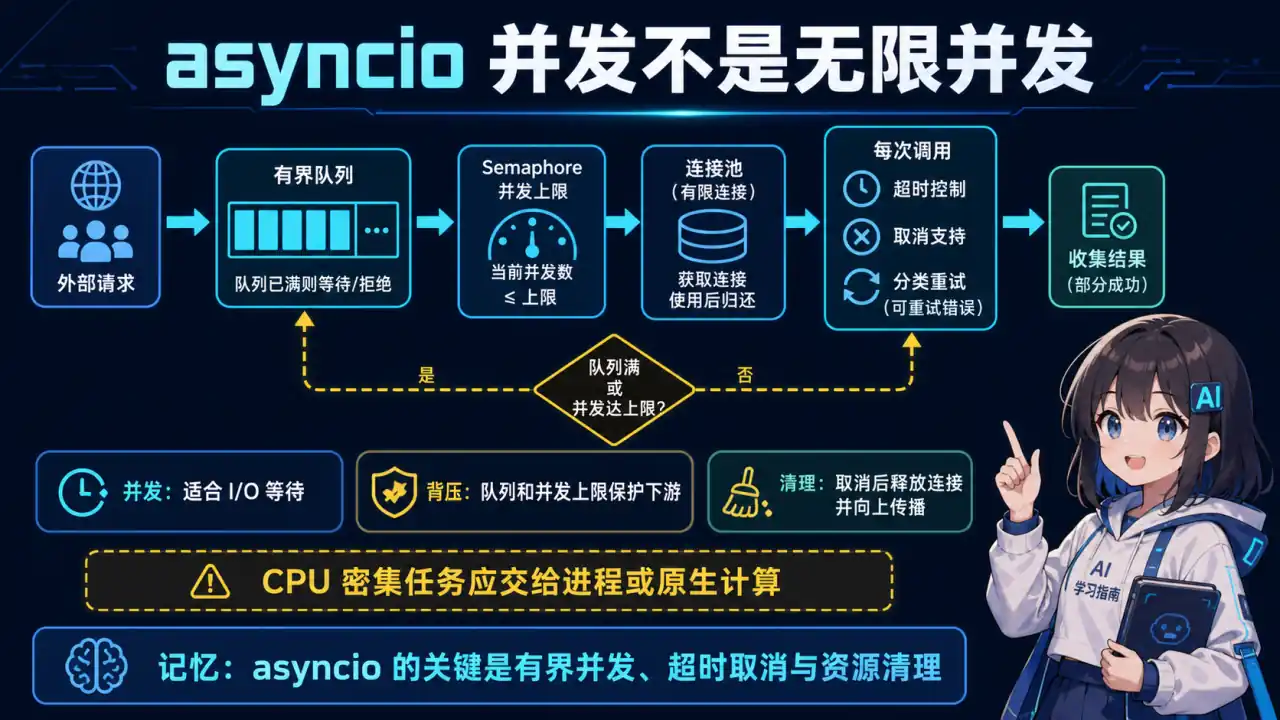
🧠 图解记忆:为什么 AI 应用需要 asyncio;点击图片可查看原图。
💡 答案要点
为什么 AI 应用需要 asyncio?
LLM API 调用 = I/O 密集型(网络等待远大于计算)。asyncio 让单线程并发成为可能:
传统同步(串行):
请求1 → 等待API 3s → 请求2 → 等待API 3s → 总计 6s
  ↓ 不高效,CPU 全在等

异步并发:
请求1 ──等待API 3s──→ 处理结果
请求2 ──等待API 3s──→ 处理结果   总计 3s(并行)
核心概念:
| 概念 | 说明 |
|---|---|
async def | 定义协程函数,不能用 return,要用 await |
await | 等待另一个协程完成,释放控制权 |
asyncio.gather() | 并发执行多个协程 |
asyncio.create_task() | 创建任务(后台执行) |
asyncio.Semaphore | 控制并发数(限流) |
典型 AI 应用场景:
展开 Python 代码示例(37 行)
python
import asyncio
from openai import AsyncOpenAI

client = AsyncOpenAI()

# 场景1:并发调用多个 LLM(批量生成)
async def batch_generate(prompts: list[str]):
    tasks = [client.chat.completions.create(
        model="gpt-4o",
        messages=[{"role": "user", "content": p}]
    ) for p in prompts]

    responses = await asyncio.gather(*tasks)
    return [r.choices[0].message.content for r in responses]

# 场景2:带并发限制的调用(Semaphore)
semaphore = asyncio.Semaphore(5)  # 最多5个并发

async def limited_call(prompt: str):
    async with semaphore:
        return await client.chat.completions.create(
            model="gpt-4o",
            messages=[{"role": "user", "content": prompt}]
        )

# 场景3:超时控制
async def call_with_timeout(prompt: str, timeout=30):
    try:
        return await asyncio.wait_for(
            client.chat.completions.create(
                model="gpt-4o",
                messages=[{"role": "user", "content": prompt}]
            ),
            timeout=timeout
        )
    except asyncio.TimeoutError:
        return {"error": "timeout"}
生产级异步封装:
python
class AsyncLLMClient:
    """带重试 + 并发控制 + 超时的异步 LLM 客户端"""

    def __init__(self, max_concurrent=10, timeout=60):
        self.client = AsyncOpenAI()
        self.semaphore = asyncio.Semaphore(max_concurrent)
        self.timeout = timeout

    async def chat(self, prompt: str, retry=3) -> str:
        for attempt in range(retry):
            try:
                async with self.semaphore:
                    response = await asyncio.wait_for(
                        self.client.chat.completions.create(
                            model="gpt-4o",
                            messages=[{"role": "user", "content": prompt}]
                        ),
                        timeout=self.timeout
                    )
                    return response.choices[0].message.content
            except (asyncio.TimeoutError, Exception) as e:
                if attempt == retry - 1:
                    raise
                await asyncio.sleep(2 ** attempt)  # 指数退避

    async def batch_chat(self, prompts: list[str]) -> list[str]:
        tasks = [self.chat(p) for p in prompts]
        return await asyncio.gather(*tasks)
面试话术:
"LLM API 调用通常是 I/O 密集型,asyncio 可以让等待网络响应的时间服务其他请求。但异步不等于无限并发:还需要 Semaphore 或连接池限制、超时、取消传播、针对可重试错误的退避,以及下游过载时的背压。收益应在供应商限流和目标流量下压测。"
📚 参考:Python asyncio 官方文档