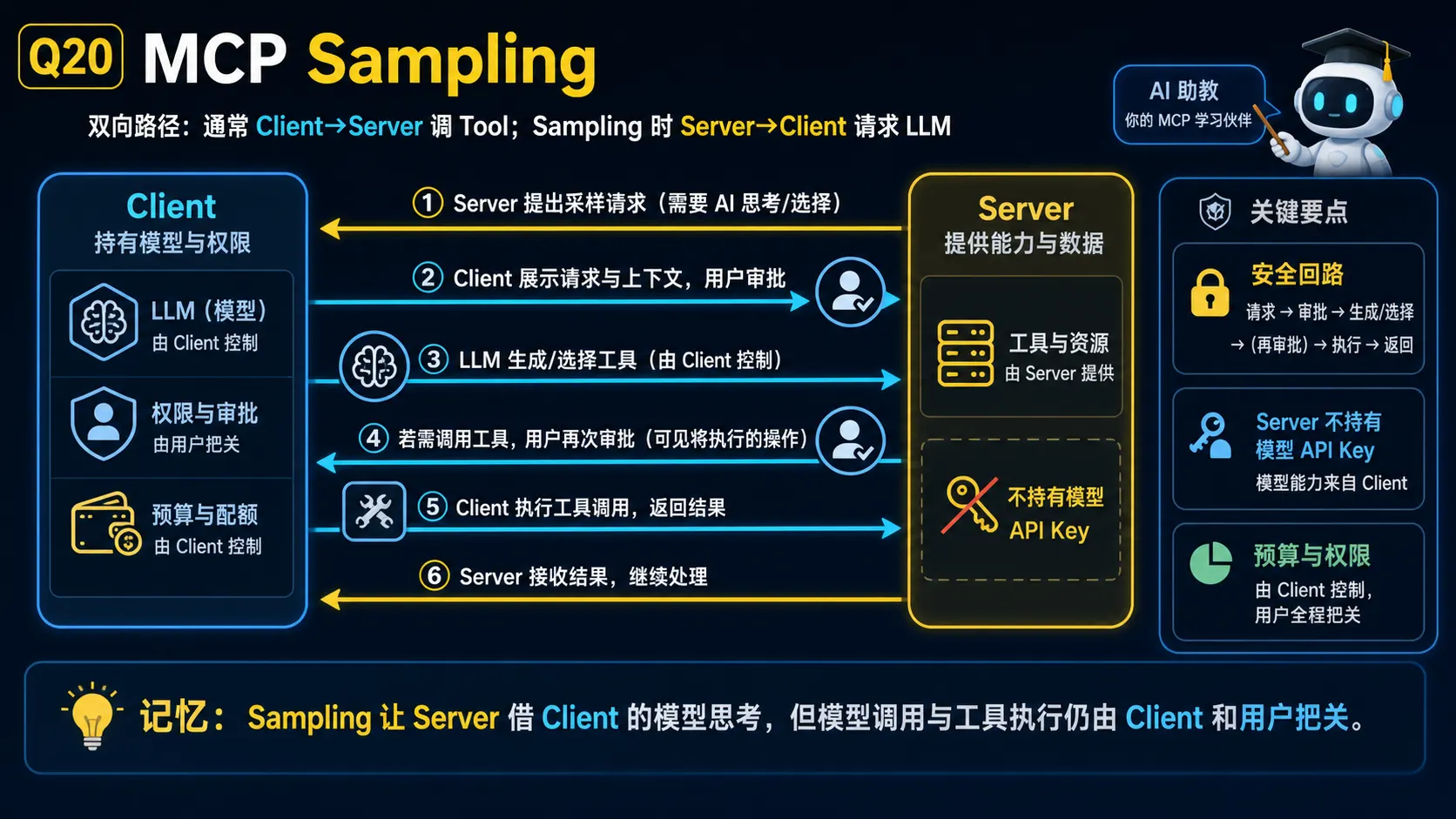
🧠 图解记忆: Sampling 让 Server 借 Client 的模型思考,但模型调用与工具执行仍由 Client 和用户把关。
💡 答案要点
Sampling 是什么:
MCP Sampling(采样原语)是 MCP 协议的一个扩展机制,允许 MCP Server 请求 MCP Client 调用 LLM(而非传统的 Client 调用 Server)。这是 MCP 协议中最重要的双向能力之一。
Sampling 的核心价值:
| 能力 | 说明 |
|---|---|
| Server 发起的 LLM 调用 | Server 可以请求 Client 让 LLM 生成内容 |
| Tool-enabled Sampling | Server 请求 LLM 时可以带上 Tools,LLM 可以调用工具并多轮循环 |
| Human-in-the-Loop | 所有 Sampling 必须有人工审批环节 |
| 无 API Key | Server 不需要持有 LLM API Key,所有调用通过 Client 控制 |
Sampling vs 传统 Tool Calling 的本质区别:
传统 Tool Calling(单向):
Client(AI Model)→ 调用 Server 的工具
Server 是被动的,Client 是主动的

MCP Sampling(双向):
Server → 请求 Client 调用 LLM(带工具)
Server 是主动的,Client 提供 LLM 资源
📋 详细答案
Sampling 协议流程
1. Server 请求 Sampling:
json
{
  "method": "sampling/createMessage",
  "params": {
    "messages": [...],
    "tools": [{"name": "get_weather", ...}],
    "systemPrompt": "你是一个有帮助的助手",
    "maxTokens": 1000
  }
}
2. Client 做 Human-in-the-Loop 审批:
Server 发送采样请求 → Client 展示 UI 给用户 → 用户审批/修改 → Client 转发给 LLM3. LLM 处理(可能带工具调用):
如果 LLM 选择调用工具:
json
{
  "stopReason": "toolUse",
  "content": [
    {"type": "tool_use", "name": "get_weather", "input": {"city": "Paris"}},
    {"type": "tool_use", "name": "get_weather", "input": {"city": "London"}}
  ]
}
4. 多轮工具循环:
Server → Client → LLM → tool_use
LLM 返回 tool_use → Server 执行工具 → Server 发送新 Sampling(带 tool_results)
→ 重复,直到 LLM 返回最终文本
完整序列图:
Server → Client: sampling/createMessage (messages + tools)
Client → User: 展示采样请求,用户审批
User → Client: 批准/修改
Client → LLM: 转发请求
LLM → Client: tool_use (weather)
Client → User: 展示工具调用,用户审批
User → Client: 批准
Client → Server: tool_use 结果
Server → Client: sampling/createMessage (history + tool_results)
Client → User: 展示继续请求
User → Client: 批准
Client → LLM: 转发 tool_results
LLM → Client: 最终文本响应
Client → User: 展示最终响应
User → Client: 批准
Client → Server: 最终响应
为什么 Sampling 让 Server 实现 Agentic 行为?
传统架构:
Agent(外部)→ MCP Server(工具)
Agent 是大脑,Server 是手
Server 被动等待 Agent 调用
Sampling 架构:
MCP Server(内置 LLM 能力)
Server 可以主动思考(通过 Sampling)
Server 可以调用工具(通过 Sampling 中的 tools)
Server 自己就是 Agent!
典型应用场景:
| 场景 | Sampling 如何实现 |
|---|---|
| 智能知识库 | Server 收到查询 → 通过 Sampling 让 LLM 分析 → 生成 RAG 查询 → 检索 → Sampling 总结 |
| 数据分析 Agent | Server 收到分析请求 → Sampling 让 LLM 写 SQL → 执行 → Sampling 解释结果 |
| 自动化工作流 | Server 收到触发 → Sampling 让 LLM 决策 → Sampling 调用工具执行 → 循环 |
Human-in-the-Loop 必须性:
⚠️ MCP 规范要求:采样请求必须有人工审批环节
Why:
- Server 发起的 LLM 调用可能产生有害内容
- 没有人工监督的自动生成不符合安全要求
- 用户需要知道并控制 AI 何时被调用

实践要求:
- Client 必须展示 UI 给用户审批
- 必须允许用户修改 prompt
- 最终响应必须经过用户批准才能返回给 Server
面试话术:
"MCP Sampling 是协议中最容易被忽视但最重要的能力——它让 Server 从'工具提供方'变成'主动思考方'。传统模式下 Server 被动等待 Client 调用,但 Sampling 让 Server 可以主动请求 LLM 做决策、带工具多轮循环。关键约束是 Human-in-the-Loop:所有采样必须经过用户审批,这既保证了安全,也意味着 Server 不能自主运行。实际应用中,智能知识库可以用 Sampling 做 RAG,数据分析 Agent 可以用它来写 SQL 执行后解释结果。"
⭐ 面试加分项:
- 能画出完整的 Sampling 序列图(包括多轮工具循环)
- 理解 Tool-enabled Sampling 和普通 Sampling 的区别
- 知道 Sampling 与传统 function calling 的设计哲学差异